

Vegan Laghman
Ingredients
For the noodles:
2 cups (250g) flour
1 tbsp vinegar
1 tsp baking soda
1/2 cup (120ml) water
For the stew:
1 onion, diced
4 cloves garlic, minced
2 red bell peppers, chopped into strips
5 tomatoes, roughly chopped
3 cups (300g) mushrooms, chopped
1.5 cups (375ml) vegetable broth
2 tbsp soy sauce
2 tbsp tomato paste
Salt
Pepper
Instructions
- At least one hour prior to cooking, combine the noodle ingredients in a mixing bowl. Mix to create a smooth dough, and cover with a cloth and let sit for at least thirty minutes.\
- After 30 minutes, flatten the dough on a floured surface. Cut the dough into 1/2 inch (1cm) wide strips, then cover with a cloth and let sit for at least thirty minutes.\
- Once the noodles are ready, boil water and stretch the noodles. There are a couple of methods for doing this, depending on how well your dough is holding together. One option is to hold one end of the strip between a thumb and forefinger, gently pinching along the noodle to stretch it. Another option is to lay the noodle on a floured surface, gently extending the noodle by pressing along the noodle's length. Pull or press the noodles until they are roughly 18 inches (36cm) long, then place in the boiling water. Boil for 1-2 minutes, or until tender. \
- Once the noodles are ready, make the stew. Heat oil in a pan over high heat, then add the onions and garlic. Sautee for 2 minutes, or until the onion is translucent.\
- Add the peppers and mushrooms, cooking for another 3 minutes. \
- Add the tomatoes, tomato paste, soy sauce, and vegetable broth, then stir to combine. Cook for another 2 minutes, or until the tomatoes start to dissolve, then lower the heat to medium-low. Let simmer for another 5 minutes, then serve over the noodles.
A longer and more detailed description
I feel like this is one of the more ambitious dishes I’ve made, not in the sense that it’s complicated - it’s really not - but in the sense that it’s doing something I’ve never done before and which I’ve always quietly associated with fancy cooking. I’ve never made my own noodles before. It’s exciting, and it’s fun, and I’ve been missing out in life, and perhaps, so have you.
Let’s start by making some noodles. Or sort of. Noodles, it turns out, are like every other dough-based food, where the longer the dough takes to contemplate its own existence, the happier it ends up being. Combine all your soon-to-be dough ingredients in a bowl, give them a lovely mixy mix (or a knead, if you don’t have sensory issues with dough like I do), and let it sit and rest beneath a cloth to dream dreams of noodles.
After half an hour, awaken your dough. Roll it out across a floured surface and pummel it into submission, rendering it reasonably flat. Once the dough is flattened, cut it into strips roughly a centimetre wide and twenty-five centimetres long. You can use a pizza cutter if you’re fancy, or a knife and a rough guess if you’re not. It’s whatever brings you joy. Cover the strips with a cloth and once again wander off to do something else with your life.
When you get hungry, return to your noodles. Boil some water, then turn your dough into the finest of noodle concoctions. Depending on how well your egg replacer is working, there are two options for how to stretch the noodles. Traditionally, these noodles are pulled, letting gravity do much of the work of stretching them. To do this, pinch one end of the noodle between your thumb and forefinger, then use the other hand to gently pinch and tug the noodle along its length, flattening and thinning it. Once the noodle is roughly 36cm long, pitch it into the water.
Alternatively, if your dough isn’t quite as structurally sound as you’d intended it to be when you had this idea, you can also flatten and lengthen the noodles along your floured surface i.e. your kitchen counter. While these won’t get quite as thin and will have a different shape - they end up more pyramidal than flat along their length - they are still very tasty. For this method, lay your noodle out on your floured surface and gently press with two fingers along the noodle’s length, flattening and lengthening it. For my camping buddies out there, the motion is not unlike getting the air out of a sleeping bag before rolling it up. Once again, flatten each noodle until it’s roughly 36cm long, then add it to the water. Boil each noodle for 1-2 minutes or until it’s tender, then drain the noodles and set aside.
Now it’s time for the stew, and this is - thankfully - much quicker than the noodles. Heat your oil over high heat, then add (say it with me) onions and garlic (well done). Cook those until whenever, then add the peppers and mushrooms. Cook these until the mushrooms start to go soft, then add in all the sauces, pastes, and liquids and give it all a good mixy mix. Lower the heat and let it simmer for another five minutes or so, then pour the stew over the noodles. Ас болсын and ئىشتىھايىڭىز ياخشى بولسۇن!
Substitutions and suggestions
For the noodles - I cannot overstate how worth it it is to make your own noodles. They’re delicious, they’re fun, and there’s nothing quite like them. I was delighted with how they turned out, and I’m going to be making them more often. That said, I also understand that they are a time commitment that not everyone has, which is also perfectly fine. One option would be to substitute the pulled noodles for udon, fettucine, or (dark horse option) lasagna noodles that have been sliced into thinner strips. The idea here is to have thick noodles undergirding the stew, so pick a noodle that can be the star of the show.
What I changed to make it vegan
The noodles themselves are ordinarily made with eggs, which I substituted with baking soda and vinegar. This does change the taste and consistency, but not radically so, and it’s still excellent, even if a bit harder to work with. The stew is also made with meat, but that was easier to work around. Mushrooms are always tasty.
What to listen to while you make this
You are not fully prepared for how excellent Hassak is, particularly their Hassak III album.
A bit more context for this dish
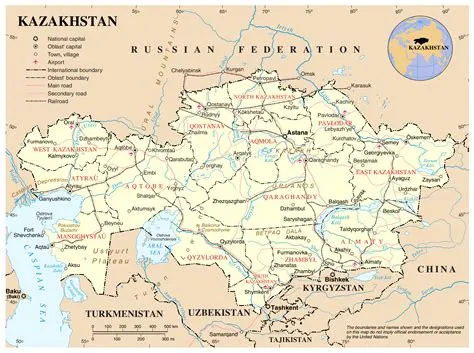
This is arguably our first foray into central Asian cuisine, and it is, at the very least, our first foray into the cuisine of the peoples of the central Asian steppes. While there are similarities across central Asia, each country is also unique, with Kazakhstan being a good illustration of where those differences come into play.
Much of Kazakh culinary tradition derives from the Kazakh traditional lifestyle. Defined by nomadic herding across the steppes, Kazakh cuisine is heavily reliant on meat and milk, especially salted and sour milks and cheeses. Kazakh cooking techniques are not terribly complex, since all dishes Kazakh herders needed for cooking also needed to be readily portable. Kazakh cooks boiled ingredients in large pots called kazans, then carried them with them as they travelled on with their herds, moving from grazing ground to grazing ground.
Kazakhstan is, however, a massive country with a diverse population, and much like any diverse nation, recipes from a wide variety of peoples and traditions have blended together to create a new form of Kazakh cuisine, one which maintains the spirit of the nomadic herders and the importance of simple, delicious meals, with ingredients and ideas from their neighbours and beyond. Russians, Koreans, Uzbeks, and Uyghurs have all left their own marks on Kazakh cuisine, with bread and pastries and dumplings being shared across cultures. Laghman, now popular throughout central Asia, is itself not originally Kazakh, but rather Uyghur, having travelled with Uyghur traders as they moved into the valleys to their west.
I discussed the history of Uyghur cuisine at length in my China recipe, and, at the risk of not repeating myself, recommend reading that if you want more of the history of Uyghur cuisine specifically. Instead, for this post, it’s more interesting to consider the link between not only the Kazakhs and the Uyghurs, but the general cultural and linguistic similarities between the peoples of the central Asian steppes.
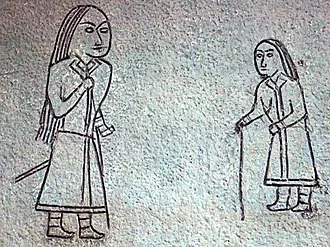 Göktürk petroglyphs in Mongolia (I promise this is relevant) (Source: University of Washington)
The peoples of central Asia are largely Turkic peoples. They speak Turkic languages, share common Turkic traditions, and have a great deal of commonality across a wide geographic area. However, like many peoples that live in an area, these Turkic peoples have not always lived in central Asia. While estimates are that Turkic peoples migrated into central Asia between the 4th and 11th centuries CE, it’s unclear as to where, exactly, they came from.
One potential origin lies with the Göktürks, a nomadic people originally from Mongolia. Ostensibly, at least. Their origin, too, is nebulous, with Chinese sources debating where, exactly, they came from or what their history was at all. By the end of the 6th century CE, however, the Göktürks had established the first Turkic Khaganate, controlling land from the northern Chinese frontier west to the Caspian Sea. This empire, however, collapsed, with khaganates rising and falling repeatedly throughout the next few centuries.
What’s interesting, though, is that the name of the first khaganate - “Turk” - stuck. While the people living under the khaganate did not ascribe this name to themselves, for outsiders, “Turk” became the descriptor of these people from Mongolia and their language and traditions. Even as the Göktürks themselves fell, other khaganates - the Uyghur Khaganate, the Kara-Khanid Khanate, the Kyrgyz Khanate - took their place, reiterating and repeating a fundamentally Turkic identity. When the Golden Horde swept through central Asia and collapsed, the khaganates that rose from its ashes had melded with the local Turkic traditions to become Turco-Mongol rather than purely Mongolian. This Turkic identity defined the people of the region, even in the face of empire after empire.
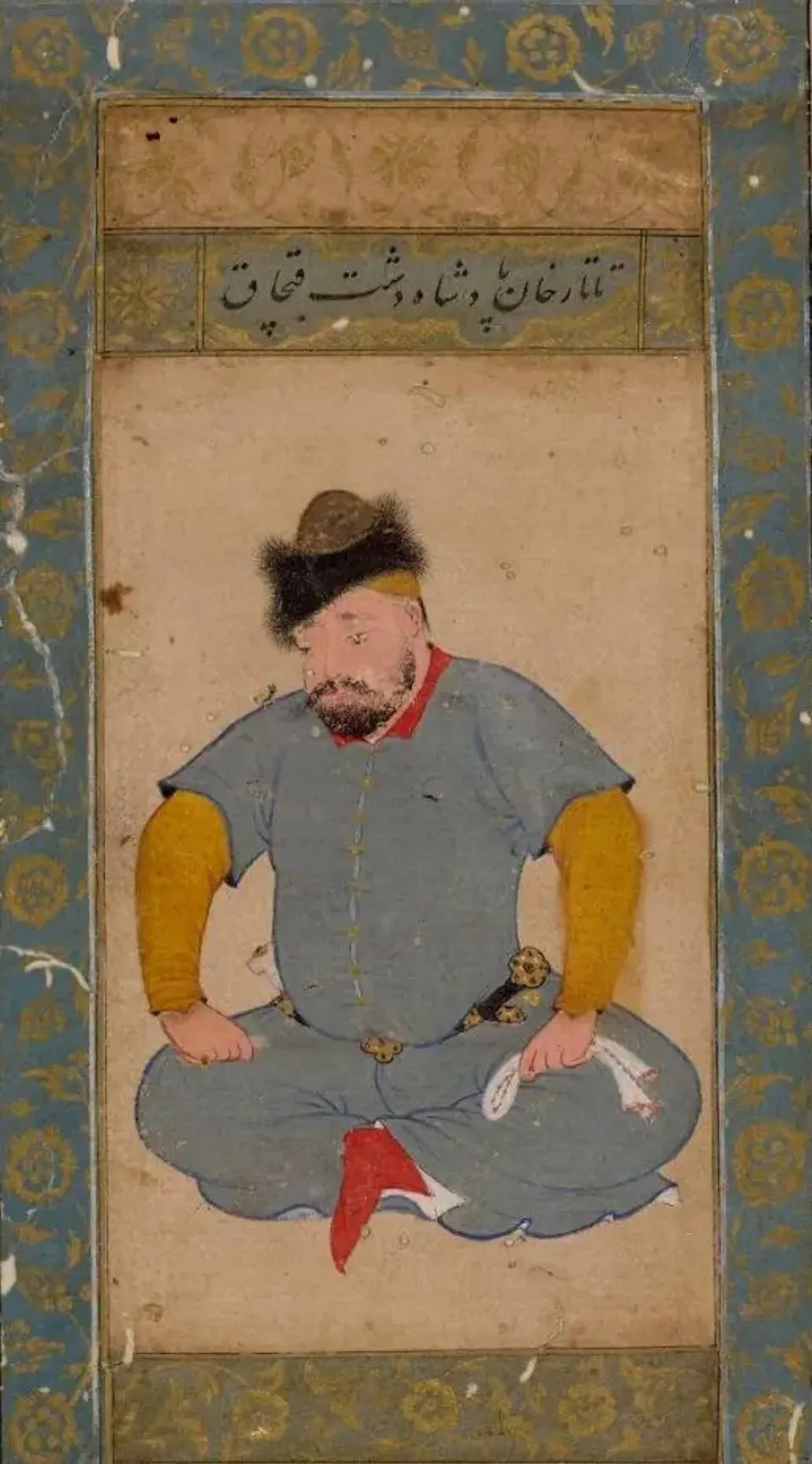 Portrait of the 16th century padishah of Dast-i Qipchaq (Source: British Museum)
When trying to pin down where Turkic people originated, however, genetic studies provide interesting hints about how identities form and who gets to call themselves a people. In their 2017 paper, Lee and Kuang analysed the DNA of Turkic peoples from throughout central Asia, and found that, rather than being the product of a mass migration into central Asia, the people that now populate the central Asian steppes are wildly diverse. Each of these ethnic groups is their own group, united with their neighbours by language and tradition, but genetically distinct. Through wave after wave of conquest and khans, the people themselves remained the same, instead adopting new languages and traditions.
“Turkic” as an identity isn’t a genetic one, but rather, a cultural one. Like so many of the nations we’ve discussed in this series, identity isn’t always something that a person is born with, but rather, the product of language, culture, belief, and community. While there absolutely are individual ethnic groups with their own rich traditions, the over-arcing family to which they belong is one constructed over centuries by the people within it, shaping one another into a shared tradition and community.
It’s this that sticks with me as I pull my noodles. The recipe for laghman noodles is a Uyghur one, but one that is popular throughout central Asia, and especially Kazakhstan. Rather than an adherence to a strict definition of identity, modern Kazakh cuisine reflects its Turkic roots and tradition in looking at the world around it and absorbing it into itself. Laghman noodles became Kazakh much as the Kazakhs became Turkic, through forging identity and defining themselves on experience rather than genetics.